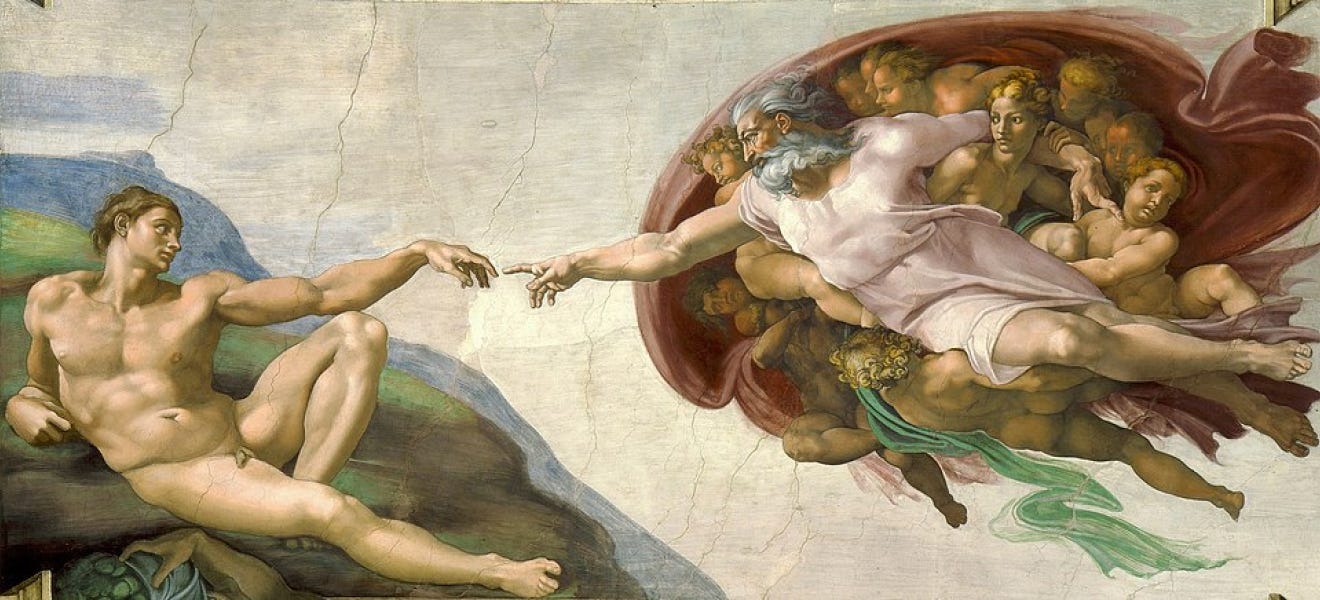
Michelangelo was a highly controversial artist. Some people did not like him. For example, Sir Joshua Reynolds, the founder of the Royal Academy of Arts, once called Michelangelo “the first great corruptor of the natural taste of mankind.”
Sir Joshua Reynolds wrote down
“The works of Michael Angelo, though they have great force and grandeur, are not always to be considered as models of perfect beauty. His exaggeration of the muscular parts, and his frequent deviation from the common proportions of nature, have been the source of that corruption of taste which has prevailed in many schools.”
Those who admire Michelangelo, such as Vasari, described him as a god descended from heaven.
Although Vasari was a student of Michelangelo, the fact that he rose to an almost legendary status shows how extraordinarily important Michelangelo was in the history of art.
The main reason, of course, lies in his exceptional level of skill. When we mentioned earlier, da Vinci excelled at depicting visible reality, Raphael at achieving balance across multiple aspects, while Michelangelo stood out for his precise representation of the human body.
Michelangelo Buonarroti was born in 1475 in the small town of Caprese (now known as Caprese Michelangelo), in the Republic of Florence. His family belonged to the minor Florentine nobility, though their fortunes had declined significantly by his birth. The Buonarroti claimed descent from the ancient Counts of Canossa (a lineage that Michelangelo himself believed in, though it remains unproven), but in reality, the family had lost much of its wealth after their small banking business failed.
His father, Lodovico di Leonardo Buonarroti Simoni, held occasional government posts; at the time of Michelangelo’s birth, he served briefly as podestà (a local magistrate and administrator, roughly equivalent to a mayor or judicial officer) of Caprese and nearby Chiusi della Verna. From a young age, Michelangelo showed a passionate interest in drawing and art, aspiring to become a painter or sculptor. However, his father strongly disapproved of such a career, viewing it as beneath the family’s social standing and unworthy of their noble pretensions.
Lodovico saw artists as mere craftsmen rather than gentlemen, and he hoped his son would pursue a more respectable path, such as business or public office. This disapproval led to frequent conflicts, with Lodovico scolding and even beating Michelangelo for neglecting his studies in favor of sketching. Despite these obstacles, Michelangelo’s extraordinary talent soon became impossible to ignore. Around the age of 13–15 (in 1488–1490), while studying or working in the Medici-sponsored sculpture garden near San Marco in Florence — where ancient Roman statues were kept for young artists to copy — Lorenzo de’ Medici (“Lorenzo the Magnificent”), the de facto ruler of Florence and a renowned patron of the arts, noticed the boy’s remarkable skill. One famous anecdote describes Michelangelo copying an ancient faun’s head so masterfully that Lorenzo was impressed and decided to support him.
Lorenzo promptly summoned Lodovico and offered to take Michelangelo into his household, treating him like one of his own sons. In exchange, he provided Lodovico with a respectable position in the Florentine customs office (a customs post or “fattoria” role) and arranged for Michelangelo to receive a monthly stipend — sources vary slightly, but it was around 5 ducats (gold florins) per month, a generous sum for a young apprentice. Michelangelo moved into the Medici Palace, where he lived, dined with the family and intellectuals, and continued his training under the sculptor Bertoldo di Giovanni, gaining access to the Medici’s vast collection of antiquities and the humanist circle.
In1494, a coup took place in Florence. And Piero, the son of Lorenzo, was overthrown. This event marked a temporary end to the Medici family’s four-generation dominance as the de facto rulers of the city.
Michelangelo, who had maintained close connections with the Medici, fled hastily to Rome. During this period, he received a commission from a banker to sculpt a life-sized statue of Bacchus, the Roman god of wine.
The work greatly impressed Cardinal Jean de Bilhères de Lagraulas, who then commissioned Michelangelo to create the renowned Pietà.
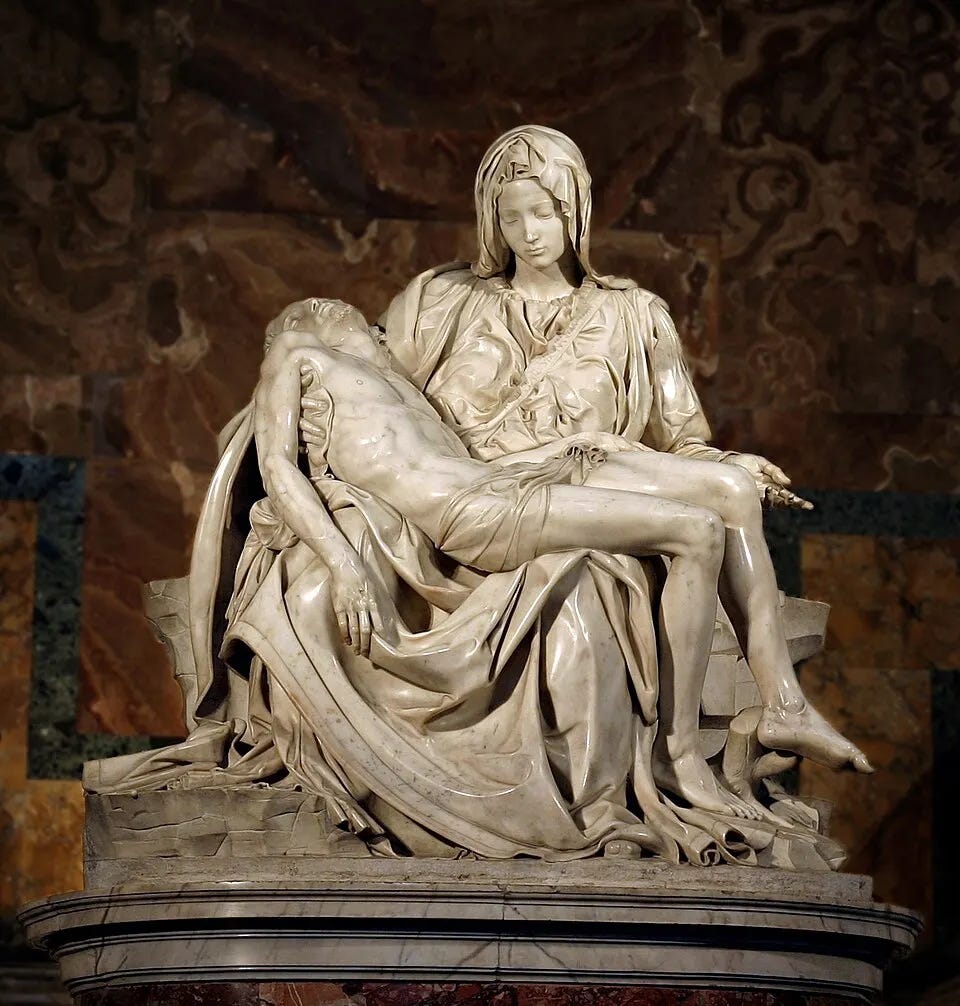
The sculpture astonished all of Rome. Regarding this statue alone, Vasari’s claim that Michelangelo was a divine talent sent from heaven was hardly an exaggeration.
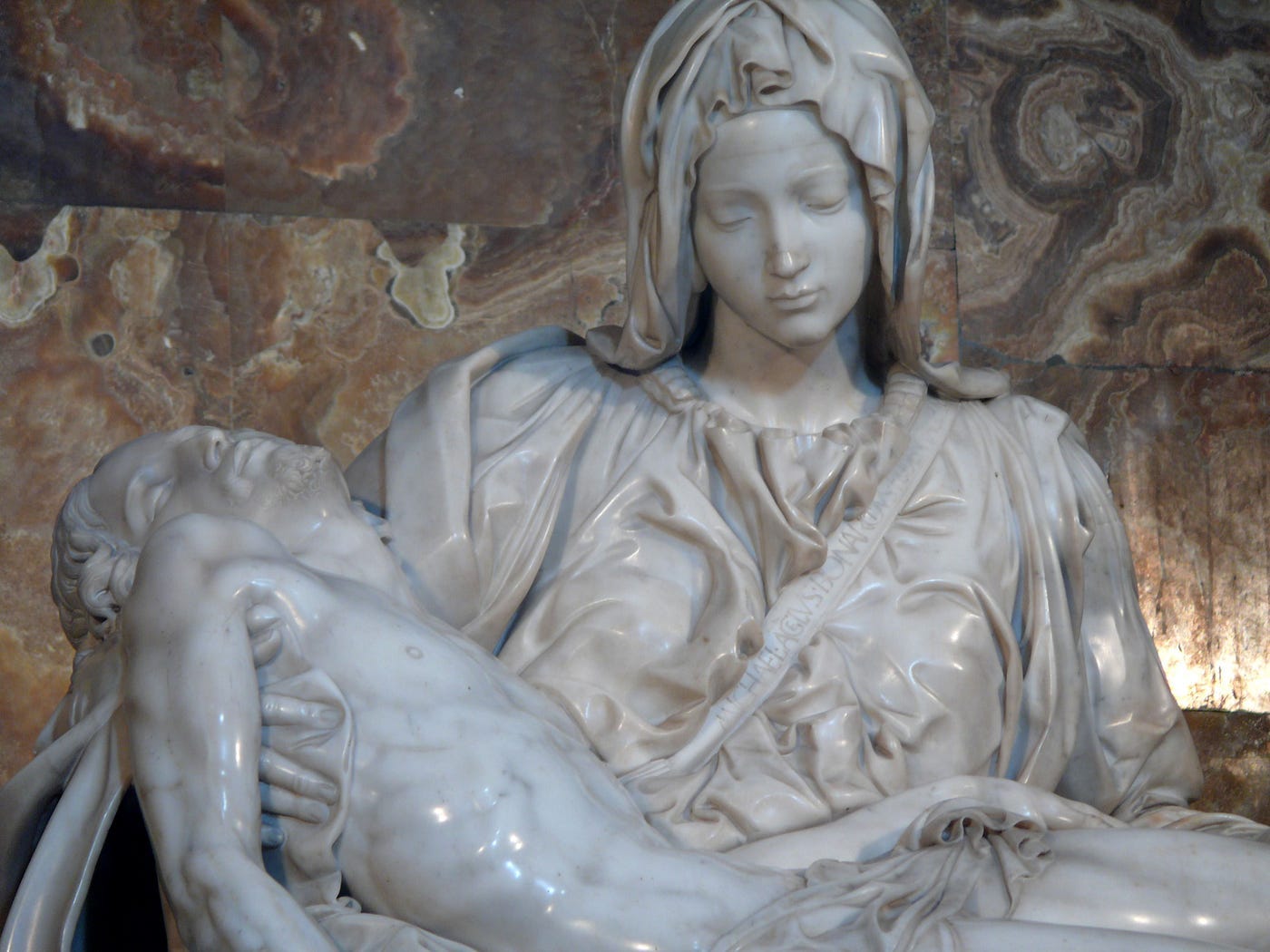
Many could not believe that such a masterpiece was created by a contemporary artist, merely 25 years old. As a result, Michelangelo carved his name onto the sash across the Virgin Mary’s chest.
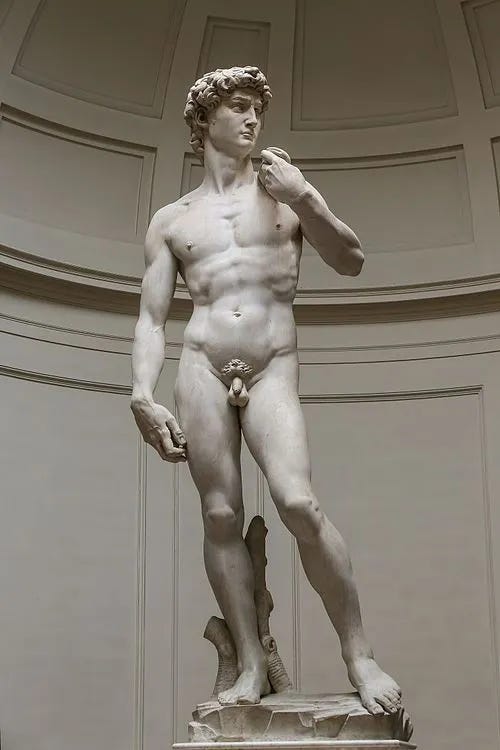
The Pietà brought Michelangelo widespread fame. In 1501, the city government of Florence commissioned him to sculpt the statue of David for the considerable sum of 400 gold florins.
Why this statue?
In the years following the overthrow of the Medici family, Florence remained in turmoil. Its external war with Pisa had ended in defeat. Therefore, the city government decided to adopt the image of David — who defeated the giant Goliath — to inspire and rally citizens.
Michelangelo completed this sculpture in just 8 months.
A lifelong project
Following the discussion of these 2 statues, let’s now turn to the largest projects he undertook in his life.
In 1505, at the age of 30, Michelangelo encountered the most significant patron of his career: Pope Julius II.
Initially, Julius II commissioned Michelangelo to construct his tomb. Michelangelo’s proposed plan includes at least forty statues arranged on three levels.
The bottom tier is approximately twenty slaves, symbolizing unrepentant human souls in bondage. The middle tier would depict various saints. At the top, two angels were to flank the Pope, drawing him directly up to heaven.
This project was too immense. Other popes continually added new tasks and commissions for Michelangelo; the work lasted for forty years. It was only delivered, then incompletely, when Michelangelo was seventy years old.
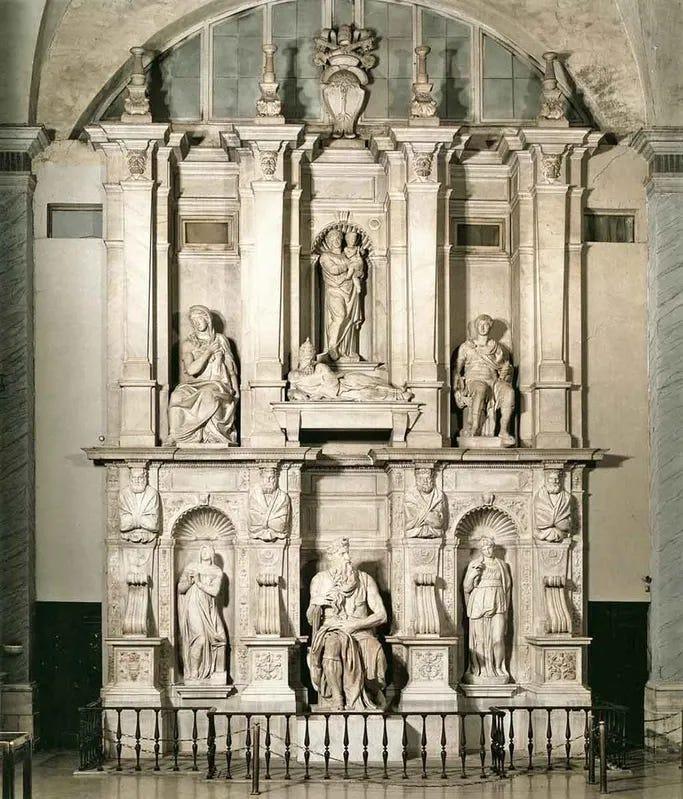
The project was interrupted three times.
The first occurred from 1508 to 1512, when Pope Julius II compelled him to paint the ceiling of the Sistine Chapel. Initially, Michelangelo refused. However, the Pope prevailed, and Michelangelo reluctantly acquiesced.
Once he began painting, his ambition grew uncontrollably, and the project expanded far beyond its original scope.
The Sistine Chapel ceiling frescoes depict the first of three stages in Christian history: nine biblical stories from the period before Moses made the covenant with God.
Beyond these nine central narratives, Michelangelo filled every corner with depictions of prophets, Jewish patriarchs, and other famous scenes from the Bible. Surrounding each main painting are twenty male nude figures.
What the Pope had initially believed would take only a few months. Michelangelo became more and more engrossed in the work, ultimately spending a full 4 years to complete it.
The second interruption to the construction of Pope Julius II’s tomb occurred due to the Pope’s death.
The next two popes, Leo X and Clement VII, both came from the Medici family. Leo X commissioned Michelangelo to return to Florence to build a funerary chapel for the Medici family.
Leo X didn’t appreciate Michelangelo’s painting and, therefore, disliked the man for two reasons.
First, while Michelangelo had been the artist most favored by Leo X’s father, Lorenzo the Magnificent, during the subsequent political upheavals in Florence, Michelangelo showed no political loyalty to the Medici family. This deeply displeased Leo X.
Second, Michelangelo was perceived as arrogant, strongly emphasizing the autonomy of the artist in his creative work, which made collaboration difficult.
However, despite his personal dislike, Leo X, perhaps the pope with the highest artistic taste among all the pontiffs, greatly admired Michelangelo’s talent in sculpture. Consequently, he still entrusted him with the project.
The project dragged on until 1534, unfinished even by the time of Pope Clement VII’s death.
Following the deaths of the two Medici popes, Michelangelo delivered it as a half-finished project.
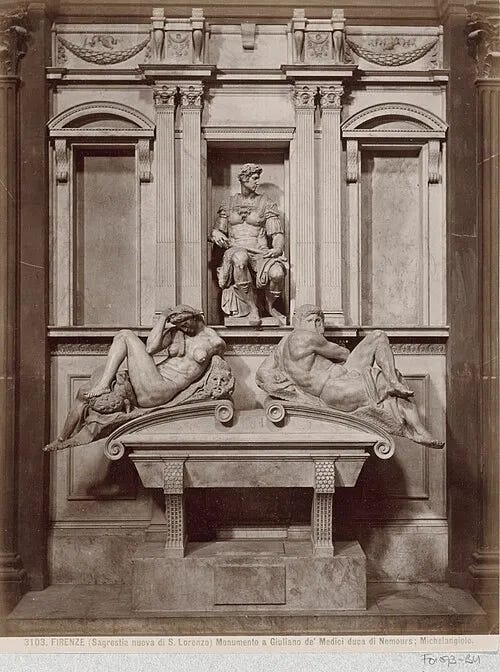
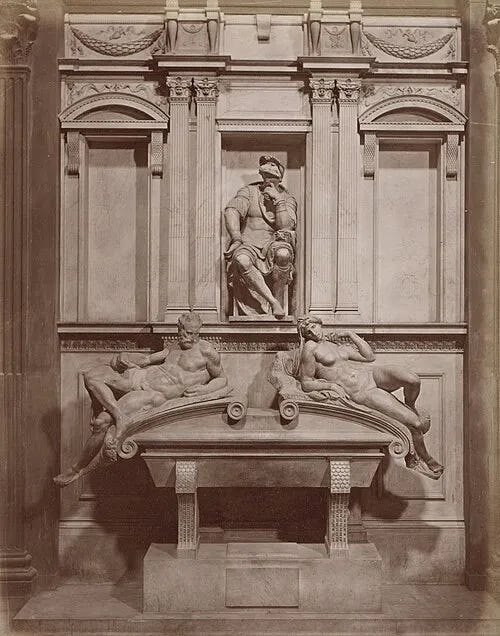
Michelangelo‘s profound importance in art history can be attributed to two additional reasons.
Firstly, Michelangelo elevated painting into a respected profession. Before his time, painters were largelyviewed as mere artisans, and their works were considered handicrafts rather than fine art. An artist‘s creativity and skill held little monetary value. As late as the 15th century, the frame for a painting often accounted for one-fifth of its cost, while expensive materials like gold leaf and ultramarine blue pigment consumed more than half of the expense.
Furthermore, painters were heavily constrained by their patrons’ demand. When working on-site in a patron’s home, the painter would typically dine with the servants.
However, through his supreme talent and formidable personality, Michelangelo secured significantly greater creative freedom for artists.
Society came to recognize the value of an artist’s creativity, thereby elevating painting from a craft to a fine art.
Even during his lifetime, Michelangelo could proudly declare, “In Italy, princes of great power and station are neither honored nor renowned. It is the painters whom everyone now treats like gods.”
Secondly, while Raphael is considered the foundational figure of later academic art, Michelangelo enjoyed a long life.
Michelangelo was eight years older than Raphael, but outlived him by a full 44 years. This longevity caused a significant shift in the direction of Western art.